Start at the roof edge
A gutter is easy to overlook because its best work is quiet. It catches water running off a roof and directs it away from walls, windows, and entrances. Without a clear route down, rain can spill over a roof edge, splash against masonry, or collect near a building’s base. The gutter is therefore more than an accessory: it is part of the boundary between a building and the weather.
On a walk, look up at how that boundary is shaped. A projecting roof may carry a visible gutter along its edge. A flat-roofed building might hide drainage behind a parapet, with an outlet appearing through the wall. Some older facades have generous cornices that conceal where water goes; simpler buildings leave the pipes in full view. These choices affect the appearance of a street even when no rain is falling.
Follow the downspout
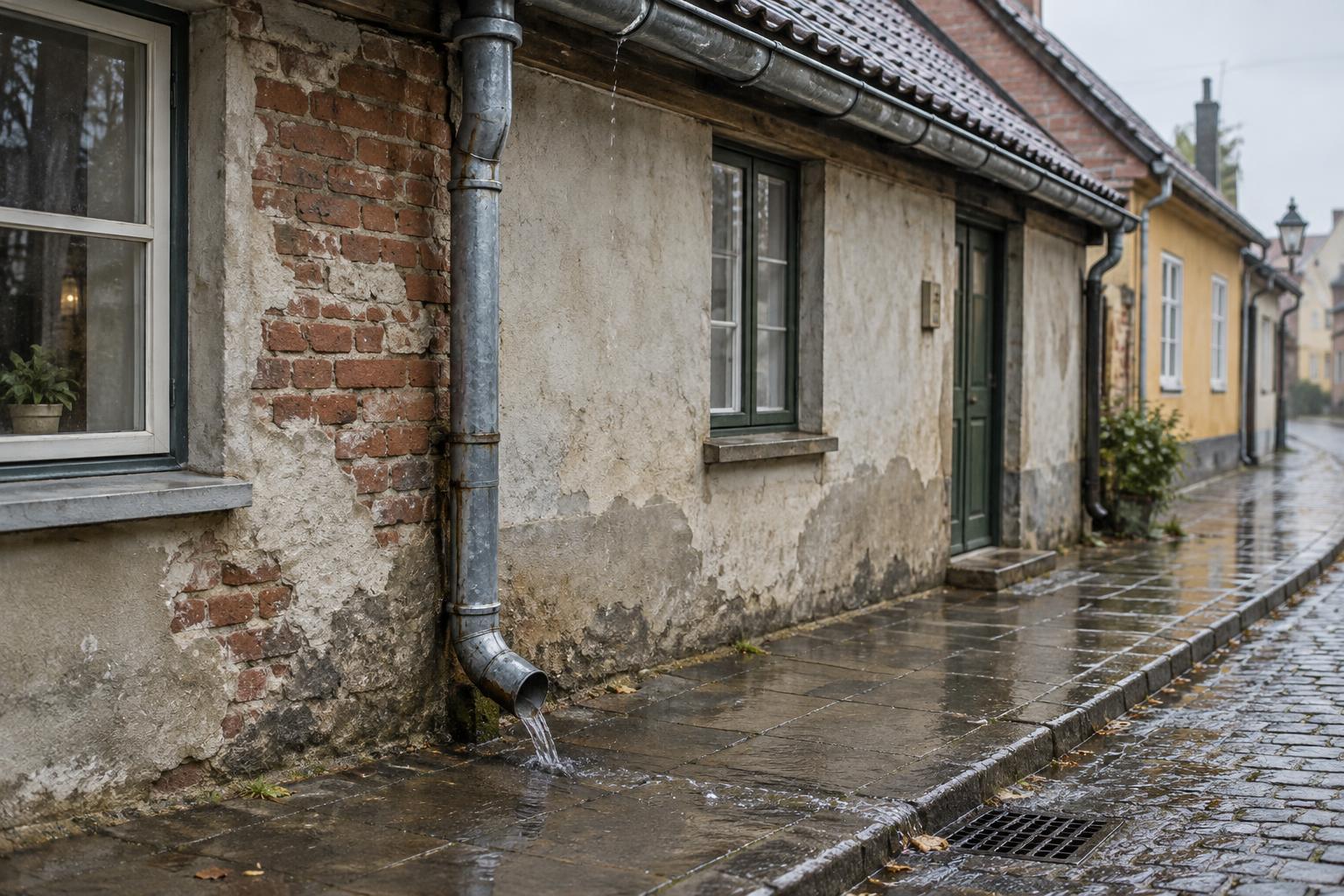
A downspout gives water a controlled path from gutter to ground. Its position can reveal a building’s practical compromises: it may run neatly beside a doorway, turn around a decorative feature, or squeeze into the narrow gap between neighboring buildings. Elbows, brackets, and joints show how the pipe has been made to fit a particular wall. A newer section in a different material may suggest a repair or alteration, though appearance alone cannot tell you when it was made.
Where the pipe ends matters as much as where it begins. Some downspouts empty into a visible surface channel; others meet a drain at ground level or disappear into a buried connection. In certain places, water is directed toward a planted area or storage container. There is no single arrangement to expect: local building practices, rainfall, available space, and later changes all influence the route.
Read the ground beneath your feet
Drainage continues across steps, courtyards, and pavements. A shallow groove beside a wall, a grate near an entrance, or a slight slope away from a threshold may be doing the same job as the gutter above. In a small courtyard, the paving can act like a broad funnel, guiding water toward one low point. On a street, a curb and gutter channel often carry runoff toward an inlet rather than letting it spread across the walking surface.
These details are easiest to understand by tracing a possible route: roof, pipe, ground, outlet. You do not need to wait for a storm. A dry-weather visit lets you notice slopes and connections without standing in runoff or blocking a narrow passage. If you do walk in the rain, observe from a safe public place; flooded grates, slippery paving, and traffic make close inspection a poor idea.
Notice what drainage does to design
Water-management features can become part of a building’s visual rhythm. Repeated downspouts divide a long facade into bays. A dark pipe can draw a vertical line across pale plaster, while a carefully placed one may almost vanish against a corner. At ground level, a row of drain covers or a continuous stone channel gives a lane its own pattern. The material is worth noticing too: metal, ceramic, stone, and plastic age differently and may sit alongside one another on the same block.
Drainage can also explain details that otherwise look odd. A raised doorstep may help separate an interior from water moving along the street. A small projecting outlet may be the visible end of a hidden roof drain. Stains beneath a joint can indicate where water has traveled, but they are not proof that a system has failed; discoloration may remain long after a problem is fixed. Reading these clues works best as a set of questions, not a diagnosis.
Make water part of a neighborhood walk
Choose a short route with varied buildings and compare how each handles the same basic task. Where does water leave the roof? Is the pipe celebrated, concealed, or worked around an existing feature? What happens where private property meets the public pavement? A row of shops, a small museum, and nearby homes may offer several answers within a few minutes’ walk.
Keep the observation respectful. View buildings from public paths, leave grates and pipes untouched, and avoid treating a stain or repair as a verdict on a property’s upkeep. The reward is a more attentive way of seeing familiar streets. Gutters and drains may not be the features that draw you to a neighborhood, but they help explain how its buildings meet the ground—and how everyday architecture accommodates the weather.