Start with the park people use today
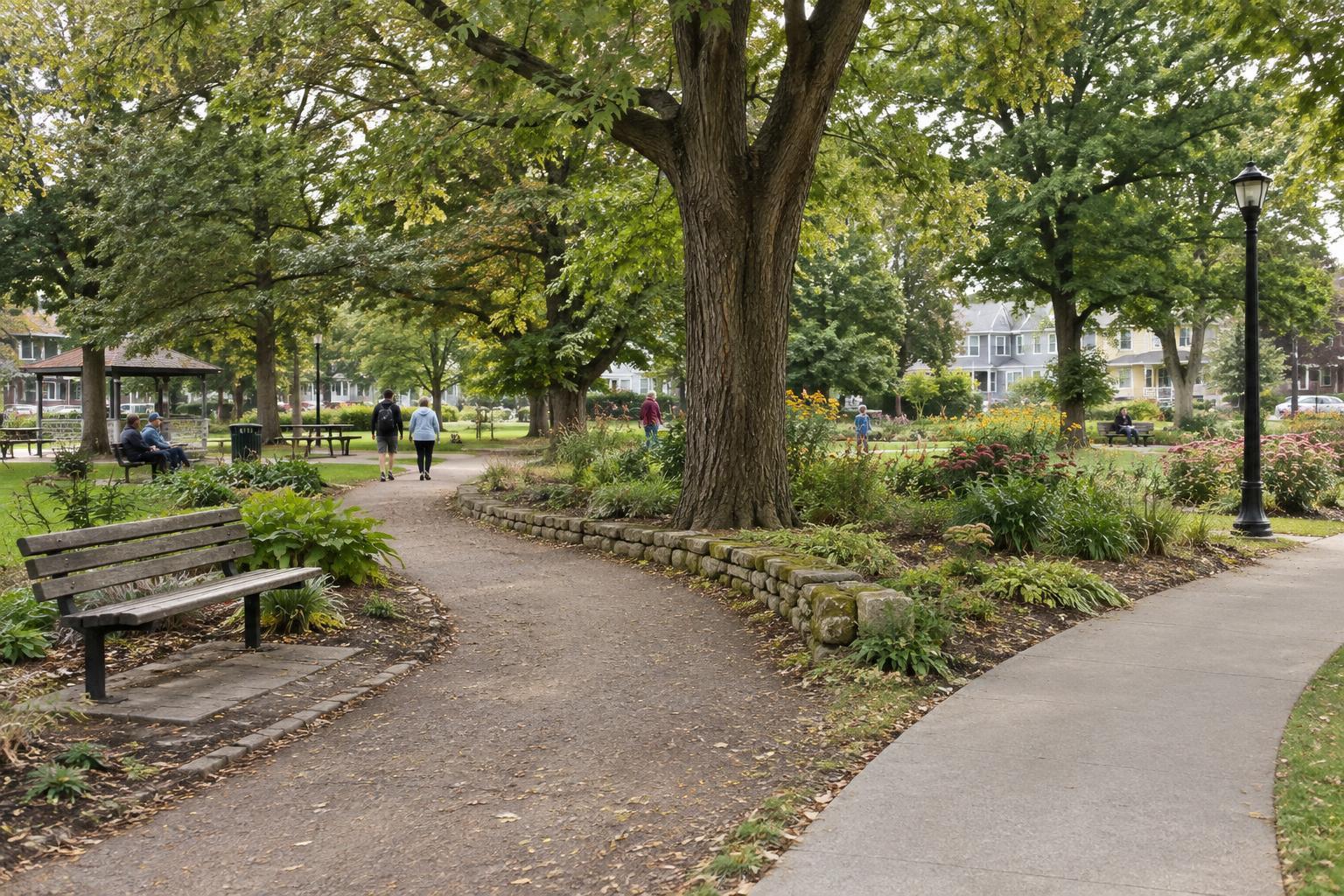
A public park is not only a preserved landscape. It is a place where people walk dogs, meet friends, exercise, rest, play, or take a shortcut. Those everyday uses are part of its heritage. Before looking for historic features, spend a little time noticing who uses the space, where people gather, and which areas seem quiet. Visit at more than one time if you can: a path that appears deserted on a weekday afternoon may be an important route at another hour.
Watch without treating visitors as exhibits. You do not need to photograph strangers or interrupt anyone to learn from the park. Benches facing one another, well-worn routes across grass, and facilities maintained for particular activities can suggest how the space works now. They cannot, on their own, tell you when a use began or whether everyone feels equally welcome there.
Read the layout as a record of choices
Walk the main paths, then look at what they connect. Entrances may face nearby homes, shops, transit stops, or civic buildings. A broad route might lead toward a formal garden, while a narrower one follows the shape of the land. Changes in paving, railings, or steps can hint at alterations, but appearance alone is an unreliable way to date them. A park that looks uniform may have been revised many times.
Notice what makes movement easy or difficult. Are there routes suitable for wheels? Do steep slopes have alternatives? Are some entrances more visible or inviting than others? These observations help you ask how the park serves people today. To understand earlier intentions, compare what you see with any available plans, photographs, or local accounts, keeping in mind that a plan shows a proposal or a moment in time—not every way people actually used the place.
Look beyond monuments and ornamental features
A statue or fountain may draw your attention first, but less conspicuous details can be just as revealing. Sports courts, shelters, drinking fountains, playgrounds, allotment plots, and public toilets reflect decisions about what a park should provide. Their condition and location may also show which activities have been supported, relocated, or allowed to disappear. Avoid assuming that an older-looking feature is original; materials can be reused, and new work can imitate an earlier style.
Trees and planting deserve the same careful reading. A straight row of trees may suggest deliberate design, while a dense patch of vegetation may reflect later growth or a different maintenance approach. Without records, it is hard to say why a particular species or planting pattern was chosen. Rather than assigning a story to each feature, note what you can see and turn it into a question you might investigate.
Ask whose park history is easiest to find
Official accounts often emphasize the opening of a park, a designer, or a major gift. Those details can be useful, but they are not the entire history. People who maintained the grounds, organized games, pushed for safer crossings, or simply used the space regularly may have left fewer easily accessible records. A park can also have a history before it became a park; its earlier uses matter to understanding how the public space came to be.
Look for more than one kind of account when researching it. Local archives, community collections, older maps, and recollections shared voluntarily may offer different perspectives. Check who created each record and what it was meant to capture. If accounts disagree, describe the difference rather than smoothing it away. If you cannot establish an earlier use or the reason for a change, leave that point open instead of filling the gap with a tidy story.
Make room for a changing place
Parks change because communities change. A new play area, a removed fence, or a different approach to planting need not mean that heritage has been lost; each may become part of the park’s story. At the same time, change can have uneven effects. An improvement for one group might make a familiar activity harder for another. Asking who benefits, who is consulted, and who can still use the space is more helpful than judging a park solely by how closely it resembles an old photograph.
For a first visit, choose a short route and record three things: a feature you can describe confidently, a change you would like to verify, and a question about how people use the park. This keeps observation separate from interpretation. Leave paths and planted areas as you found them, follow posted rules, and give other visitors room. The aim is not to uncover one definitive version of the park, but to see an ordinary shared place with greater care.