Start with a question, not a complete catalog
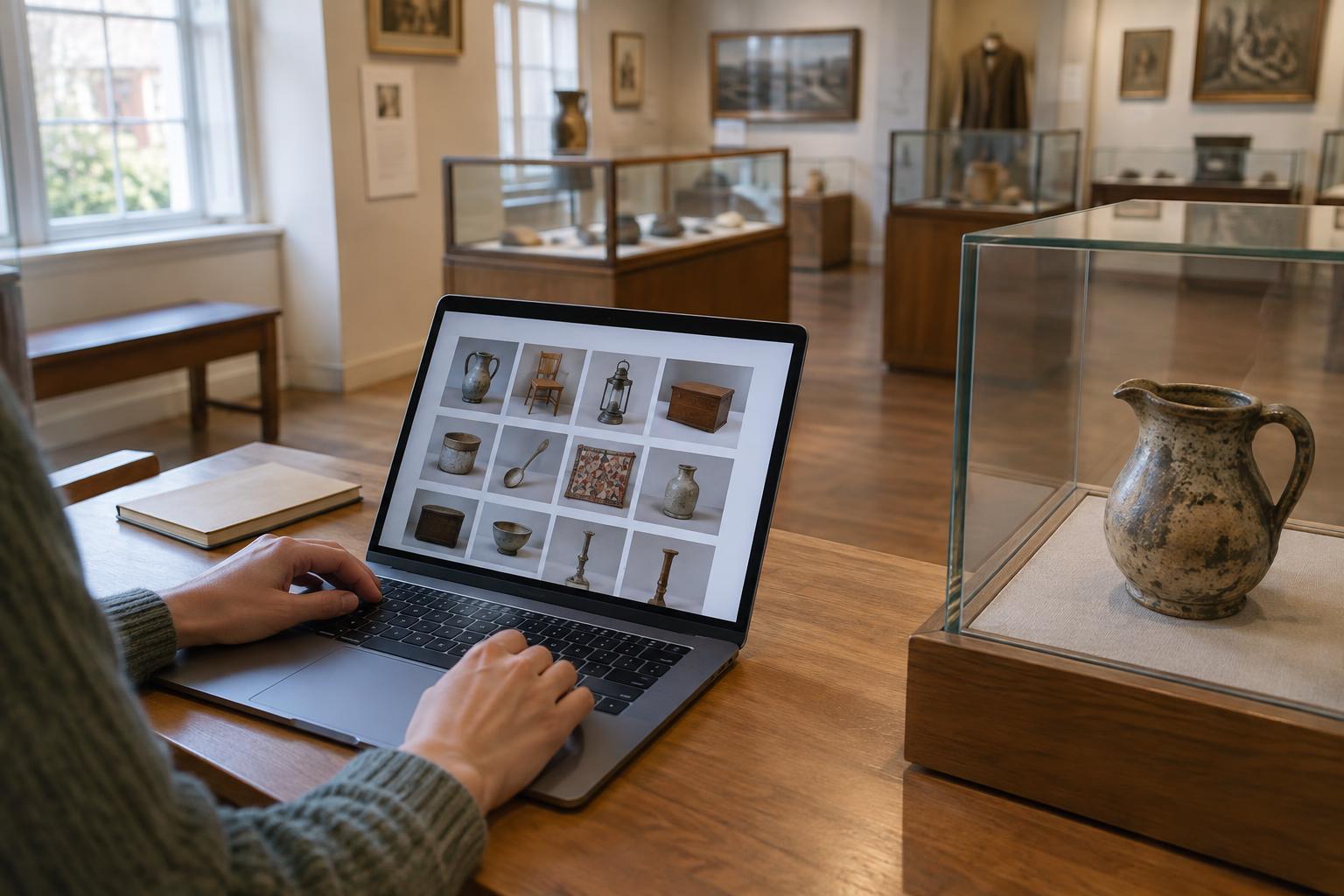
A small museum’s online collection can be an inviting doorway into a place. It can also be surprisingly large or uneven: some objects have detailed descriptions and several images, while others appear as little more than a title and an inventory number. You do not need to survey everything before you go. Begin with one question that matters to you, such as how people worked in the area, what they made at home, or how the neighborhood changed over time.
Use the museum’s search box or browse categories to find a handful of related objects. Try more than one term if your first search is thin: a search for “shop” might lead you to signs, photographs, receipts, or tools, while a search for “street” might reveal maps and views of buildings. If the site offers filters, use them to narrow the results, but spend a little time browsing outside your chosen subject. An unfamiliar object may give you a better question than the one you brought.
Read the record as carefully as the image
An image can draw you in, but the accompanying record often changes what you see. Look for the object’s materials, approximate date, dimensions, maker or previous owner, and the place associated with it. A tiny item photographed against a plain background may have been carried every day; a large one may have shaped a room. Dimensions and materials help restore a sense of scale that a screen removes.
Notice what the record does not establish, too. A date may be a range, an attribution may be uncertain, and a place name may refer to where an object was found rather than where it was made. If the museum includes a history of how an object entered the collection, read it without assuming the account is complete. Make a note of anything you would like to ask a staff member or investigate through the exhibition. The gaps can be as interesting as the facts.
Choose a few anchors for your visit
Select three to five objects or themes you would be pleased to encounter in person. Save their titles and, if available, collection numbers in a short note. Add one sentence about why each caught your attention: a repair you want to examine, a familiar street name, or a technique you cannot understand from the photograph. This gives you something specific to look for without turning your visit into a checklist.
An online collection is not necessarily a list of what is on display. Objects may be in storage, on loan, undergoing care, or shown only occasionally. Check the museum’s visitor information and any current exhibition pages for display details, opening arrangements, admission requirements, and accessibility information. If seeing a particular object is essential to your trip, contact the museum before traveling rather than assuming its online record guarantees access. A museum may not be able to accommodate every request, but asking can prevent a disappointing guess.
Connect the objects to their setting
Small museums often make the most sense when you pay attention to what surrounds them. As you browse, note references to nearby buildings, industries, communities, landscapes, or former uses of the museum’s own space. You might then plan a short walk before or after your visit to look for a street pattern, building material, or public landmark mentioned in the collection. Treat the collection as a way to notice your surroundings, not as a script for interpreting every detail.
Keep your comparisons modest. A photograph of an old storefront does not explain everything that happened on that street, and a single household object cannot stand for an entire community. If an object raises questions about whose lives were recorded and whose were not, bring that curiosity into the museum. Labels, related displays, and conversations with staff may add context that a brief online entry cannot provide.
Leave room to discover something unexpected
Once you arrive, look first at the galleries rather than at your saved list. Follow what catches your eye, then return to your chosen objects or themes if they appear. Seeing an object at its actual size, alongside others, may shift your understanding. Equally, a display you never noticed online may become the most memorable part of the visit. Your preparation has done its job if it helps you ask better questions, not if it dictates your route.
Afterward, revisit one or two online records and add what you learned in person. You may notice a detail you previously missed or realize that the display answered a question you had written down. If you want to share collection images or descriptions, check the museum’s stated reuse guidance rather than assuming that an image you can view is free to republish. A short, thoughtful follow-up lets the visit continue without trying to capture the whole museum at once.