Start with the name you can actually see
A walk through an unfamiliar neighborhood can turn a street sign into a question. Why is this lane named for a tree that is no longer visible? Does a market name describe a former use, or a newer effort to give the area a distinct identity? Names offer clues to local history, but they are not explanations on their own. A promising story may be only one of several possibilities.
Begin by recording the name exactly as it appears, including spelling, accents and any words such as Road, Square or Passage. Note where you saw it and whether nearby signs, maps or buildings use a different form. A photograph can help you check those details later, provided you take it without obstructing anyone. Look closely at the boundaries of the place, too: a historic name may refer to a wider district than the one a present-day map labels.
Build a timeline before choosing a story
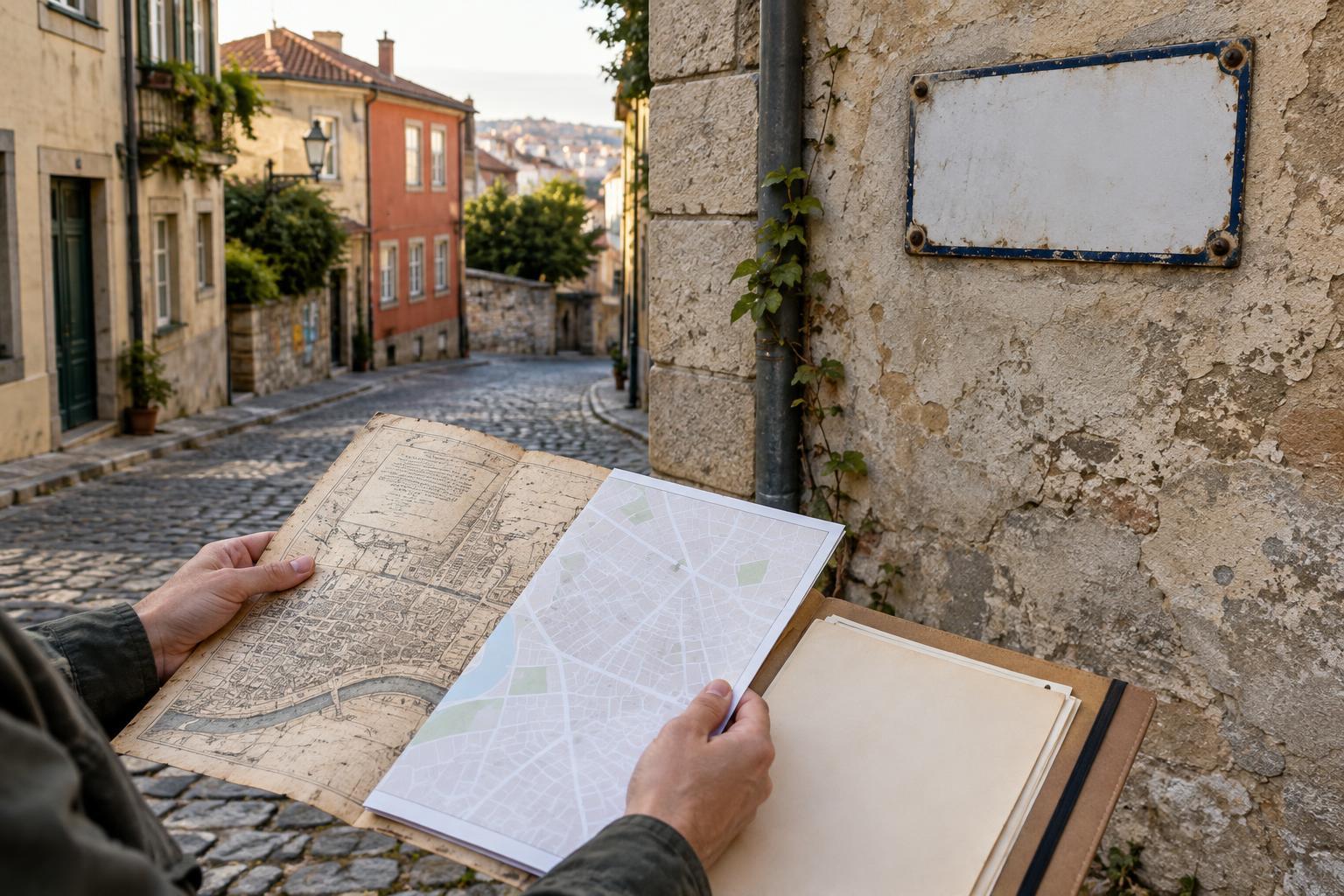
The most useful first question is often not “What does this name mean?” but “When did people begin using it?” Compare maps from different periods if you can find them through a library, archive or local history collection. An early map may show a field path where a street now runs; a later one may give it a name. That sequence will not necessarily reveal who chose the name, but it can narrow the range of plausible explanations.
Check whether the spelling, street alignment or neighboring names changed over time. A street might have been extended, divided or renamed, making a name on an old map harder to match with the place you walked. Record what each item shows and its date rather than relying on memory. If two maps disagree, keep both in your notes. The disagreement may reflect different mapmakers, informal usage or a period of transition.
Look for a record that explains the choice
Once you have a rough timeline, look for evidence of a naming decision. Depending on the place, council minutes, planning files, street directories, newspaper archives or records held by a local heritage group may help. A document proposing a name is not quite the same as proof that it was adopted, so try to check it against a later map or directory. Libraries and small museums can also point you toward the kinds of records that survive locally.
Treat explanations according to the evidence behind them. A dated record stating why a name was approved is stronger evidence for the official decision than a later anecdote. Yet the anecdote may tell you something valuable about how residents have understood the name. Keep those findings separate: “named for” is a firmer claim than “often said to refer to.” If you cannot establish an origin, saying so gives readers a clearer picture than selecting the most appealing theory.
Make room for language and living memory
Place names can pass through several languages, spellings and pronunciations. Similar-looking words do not always share an origin, and a literal translation may miss a local meaning. If a name appears in a language you do not know, seek reliable local-language resources or someone able to explain its context. Avoid building an etymology from a quick resemblance between words.
Residents may use names that never appeared on an official sign. Asking about those names can reveal landmarks, former businesses or gathering places that formal records overlook. Approach conversations as an invitation, not a request for someone to settle your research. Be clear about whether you intend to publish what you learn, and ask permission before attributing a personal account. Memories can differ without one person necessarily being careless; they may describe different decades or different parts of a neighborhood.
Let the uncertainty shape the visit
A well-researched name can change how you move through a neighborhood. Instead of treating the sign as the destination, look for the everyday setting around it: the curve of a road, a surviving workshop, a newer building on an older plot. These details may help you understand why a proposed explanation seems plausible, but they should not be presented as proof. A street called Orchard Lane, for instance, does not by itself establish where an orchard stood.
When you share the story, distinguish what a record confirms from what remains an interpretation. Give enough detail for someone else to retrace your steps, such as the type of record and its date, without claiming that one source captures every local perspective. The aim is not to solve every name on a walk. It is to notice more carefully, follow the evidence where it leads and leave space for the people who know the place in ways a map cannot show.