Start with the route, not the ornament
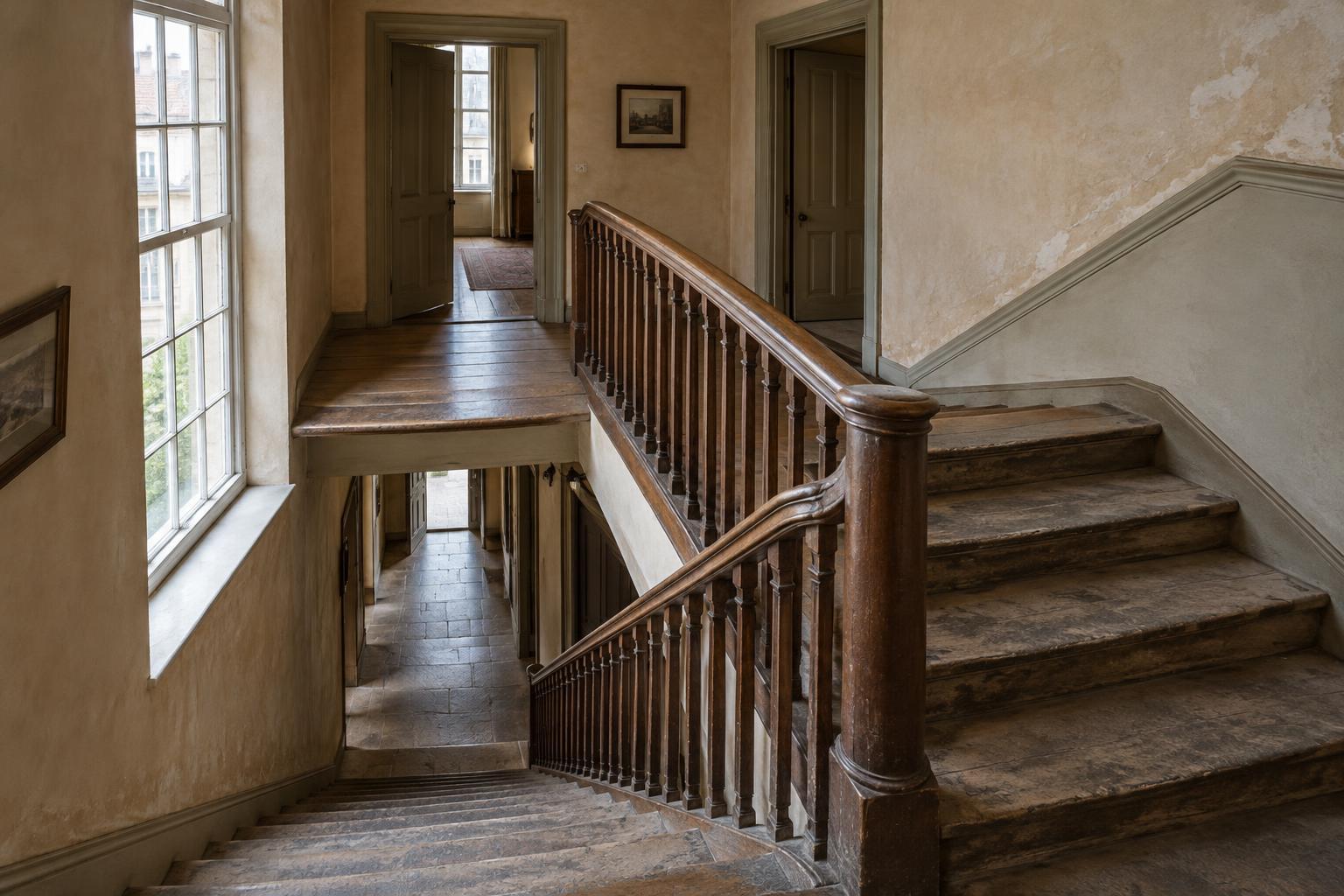
An older staircase may catch your eye because of its worn steps, carved rail or unusual turn. But its most revealing feature is often where it sits. From an entrance, can you see the stairs immediately, or do you have to pass through another room to find them? Does the route feel direct and welcoming, or narrow and tucked away? These questions help you read circulation: the paths people take between a building’s spaces.
A stair rising from a generous entrance hall can make movement between floors feel like part of a shared, visible experience. One reached through a side passage may have served a more practical route. Neither arrangement proves how every visitor used the building. Entrances move, rooms change purpose and staircases can be replaced. Treat the layout as a clue, then look for other features that support or complicate your first impression.
Width, turns and landings shape the journey
A staircase does more than connect two levels. It determines how people approach one another, where they pause and how easily they can carry things. A broad flight with a substantial landing leaves room to change direction or briefly stop without blocking the route. A steep, compact stair makes movement more deliberate and may feel suited to a limited space. The differences can suggest which routes received more room and attention.
Look closely at the landings. Do they open onto several doors, acting almost like small upstairs halls? Does one flight continue toward upper rooms while another branch leads somewhere else? A landing with a window can bring light to a route that might otherwise be enclosed. These details help explain how a floor was organized, even when its rooms are closed to visitors or now have different uses.
Wear can add another clue, but it needs care. A hollow in the middle of a tread may suggest repeated use; a polished handrail may invite the same thought. Maintenance, replacement materials and later visitors can also produce or erase such marks. Notice them without turning them into a precise account of who walked there.
More than one stair can mean more than one route
Some older buildings have a conspicuous main stair and a smaller one elsewhere. Their positions can help you imagine different journeys through the same structure. A stair near an entrance may connect rooms used for receiving guests, while another beside working areas may provide a shorter route between tasks. In a building adapted for shops, offices, flats or public use, separate stairs may instead reflect later divisions.
Follow the connections rather than assuming a fixed hierarchy. Which doors does each stair reach? Is there an easy route from one side of the building to the other, or do walls and locked doors break it up? A narrow stair is not automatically a ‘servants’ stair,’ just as a handsome one was not necessarily reserved for visitors. Its role depends on the building’s use and on changes made over time. Where a small museum or heritage site provides a floor plan, it can help you test what the visible routes suggest.
Changes leave their own circulation clues
A staircase belongs to a building’s ongoing life, not only to its original plan. An awkward doorway at a landing, a blocked opening or a sudden change in floor finish may hint that routes have been revised. A stair that ends near a partition might once have opened into a larger space. Equally, an arrangement that seems strange today may have worked well when adjoining rooms served different purposes.
Alterations can make older buildings more usable, especially when their previous routes are difficult to navigate. A lift, new handrail or changed entrance is part of the building’s circulation story too. When looking around, ask how people move through it now as well as how they may have moved through it before. The comparison often reveals more than an attempt to imagine a single, untouched past.
Read respectfully, and leave room for uncertainty
You can make these observations without leaving public areas. In a museum, library, station or other accessible older building, pause where you will not obstruct the stairs and trace the route with your eyes. Notice where the stair begins, what each landing connects and whether another route serves the same floor. Then ask what you cannot see: a closed corridor, a changed entrance or an upper level outside visitor access.
The useful question is not ‘What was this stair built for?’ as though one glance could settle it. Try ‘What kinds of movement does this arrangement make easy, visible or difficult?’ That question keeps the focus on everyday architecture. It also makes room for the building’s changes—and for the many people whose ordinary journeys have shaped its spaces.